

The first version of a digital product is almost never the final one. Once real users get involved, assumptions get tested, priorities shift, and the original plan looks very different a few months in. That reality makes the technology choice behind an MVP more consequential than most teams expect. The framework a product is built on either supports that constant change or works against it.
React has become one of the most widely used frontend frameworks for MVP development because it handles uncertainty well. It allows teams to build and ship quickly, adjust individual parts of the product without disrupting everything else, and scale the codebase as the product grows, without needing to start over.
Specifically, React is well suited to MVP development for three reasons. Its component-based architecture supports fast iteration. Its ecosystem reduces the time spent on groundwork. And its structure holds up as a product evolves from a first release into a full platform.
What React is and why it matters for MVPs
React is an open-source JavaScript library developed by Meta for building user interfaces. Rather than treating an interface as one large, interconnected block of code, React breaks it into smaller, self-contained components. Each component handles its own logic and display, and each can be developed, tested, and updated independently.
For MVP development, this matters for a practical reason. Early-stage products change constantly. A feature that seemed essential in week two may be deprioritized by week six based on what users actually do. In a component-based system, that kind of adjustment affects only the relevant component, not the entire application. So teams can respond to feedback without rewriting large sections of code.
Additionally, React’s ecosystem reduces the time it takes to reach a working product. Libraries already exist for routing, state management, authentication, form handling, and UI components. As a result, teams spend less time building infrastructure from scratch and more time building the actual product.

React compared to other frontend frameworks
Choosing a frontend framework for an MVP is partly a technical decision and partly a strategic one. Ultimately, the choice shapes how easily a product can adapt once it is in the hands of real users.
| React | Vue | Angular | Vanilla JS | |
| Learning curve | Moderate | Low | Steep | Low |
| Ecosystem size | Very large | Medium | Large | N/A |
| Flexibility | High | Medium | Low | Very high |
| Best suited for | Scalable MVPs, SaaS, platforms | Smaller apps, simple UIs | Enterprise systems | Static or minimal UI |
| Long-term scalability | Strong | Moderate | Strong | Difficult at scale |
React vs Vue.
Vue is approachable and works well for smaller applications or teams that prefer a more structured, opinionated setup. For MVPs expected to grow into larger systems, though, React’s broader ecosystem and larger community tend to make it the more durable choice over time.
React vs Angular.
Angular is a full-featured framework designed for enterprise applications with well-defined, stable requirements. That same structure, however, can slow things down at the early, fast-moving stage of an MVP when requirements are still being discovered. React’s lighter setup fits better when a team is still figuring out what the product actually needs to be.
React vs Vanilla JavaScript.
Vanilla JavaScript can build almost anything, but as an application grows, keeping the codebase organized without a framework becomes increasingly difficult. State, component logic, and UI updates all become harder to manage at scale. React, by contrast, adds enough structure to keep things maintainable without adding unnecessary overhead. That is part of why it has become a practical default for MVPs expected to grow.
Where React fits best, and where it does not
React works best for products with dynamic interfaces, real-time interactions, or frequent updates based on user behavior. SaaS platforms, dashboards, marketplaces, booking tools, and customer portals all tend to benefit from the kind of flexible, component-driven frontend React enables.
That said, it is not always the right choice. A basic marketing website or a simple landing page rarely needs the overhead of a full React setup. In those cases, a lighter solution is faster to build and easier to maintain. The relevant question is not whether React is capable, since it usually is. Instead, the question is whether the product genuinely requires an interface that will keep changing based on how users interact with it.
How React supports faster iteration during MVP Development
One of the more difficult aspects of building an MVP is managing the constant change that follows an early launch. User behavior rarely matches what a team anticipated. Features get reworked, prioritized differently, or removed entirely based on what actual usage data shows.
React’s component structure makes that process more manageable. When a feature underperforms or needs to change, the relevant component can be reworked independently, and the rest of the application is not affected. This reduces the risk and cost of iteration, which matters most during the period between launch and the first meaningful round of product updates.
We see this play out in practice. Products that launch with a React frontend can often get a significant feature update in front of users within days rather than weeks, since the change is scoped to a component rather than requiring broader architectural work. That speed of iteration is one of the primary reasons React has become a default choice for teams that expect their MVP to evolve quickly.
The wider ecosystem reinforces this too. Because libraries for common functionality already exist and are well-maintained, teams are not rebuilding solved problems. Instead, the development effort concentrates on what is specific to the product.
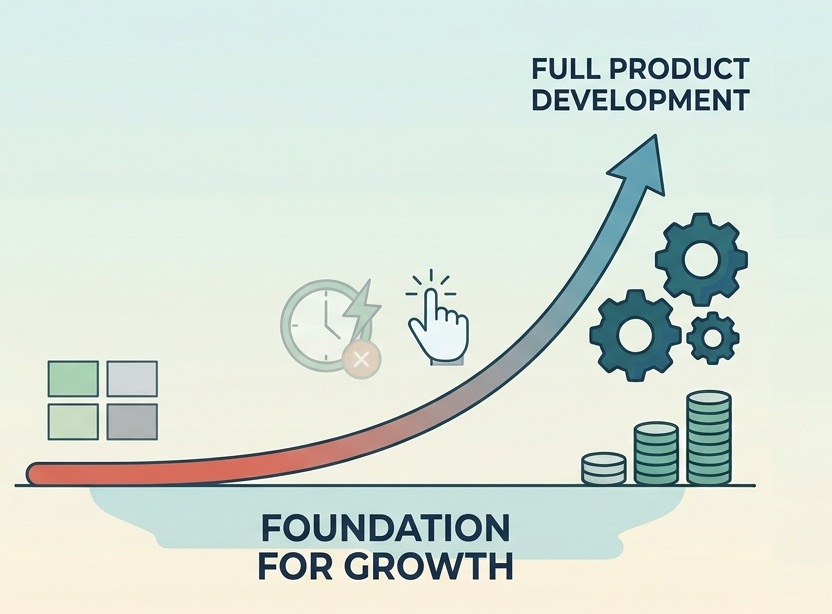
Growing from MVP to full product
A common problem in early-stage development is being forced to rebuild an application once it gains real traction. Typically, this happens when the initial technical choices cannot support the product’s growth without significant rework.
React reduces that risk. New features can be added as separate components and layered into the existing application without disrupting what is already working. So an interface that started simple can grow considerably in complexity while still resting on the same underlying architecture.
This is particularly relevant for teams that expect their product to evolve based on what users do after launch. Rather than treating the MVP as a throwaway version to be replaced later, a well-built React frontend can carry the product through multiple stages of growth. For many teams, this means React becomes not just the MVP choice but the long-term frontend strategy.
React and the path to mobile
For teams that expect to expand into mobile, React has a longer-term advantage worth considering: its relationship with React Native, the framework for building native mobile applications using React patterns.
Web and mobile remain distinct platforms, but teams already working in React find the transition to React Native considerably more manageable. Shared patterns around component structure, state management, and application logic mean less duplicated effort when mobile development becomes the next step. So for MVPs that gain traction and move toward mobile expansion, having started in React reduces the cost of that transition.
Frequently Asked Questions
- How much does a React MVP typically cost to build?
It varies by scope, but a focused MVP is generally cheaper than a full-featured product, since only core functionality gets built first. - How long does it take to build an MVP in React?
Most React MVPs take a few weeks to a couple of months, depending on complexity and integrations. - Do I need a large development team to build a React MVP?
No. A small, focused team is usually enough, since the goal is testing the core idea, not building every feature. - Can a non-technical founder manage a React product after launch?
Day-to-day content, yes. Code changes still need a developer, though React’s structure makes handoffs easier. - Is React SEO-friendly for MVPs that need organic traffic?
With proper setup, such as server-side rendering, yes. A default React setup alone is not optimized for search. - What happens if a feature React cannot easily support comes up later?
Rare, but when it does, the component structure usually lets you isolate a workaround without affecting the rest of the app. - Do I need to hire React-specific developers, or can any web developer work on it?
React developers specifically. The patterns and libraries differ enough from other frameworks that general web experience alone is not quite enough. - Will my React MVP need a rewrite once it gains real users?
Not typically. The whole point of the component structure is adding and adjusting without a rebuild.
Build your MVP on a React foundation
At Web Experts Nepal, we use React as a core part of our service to approach MVP development because it matches how early-stage products actually behave: changing quickly, adjusting based on feedback, and needing to scale without a full rebuild.
Our focus is on building the smallest functional version of a product that can generate real, useful insight from actual users, on a technical foundation that can support what comes next.
If you are working through a product idea and want to understand what a focused React MVP would look like in practice, we are happy to talk it through.
Contact UsRelated resources.
Next.js vs React: What Is The Difference And Which Should You Choose?

Why Your Website Is Slow (And What to Do About It)

HubSpot and WordPress: How To Connect The Two Platforms The Right Way
Have an idea worth building?
Share your concept with us and we’ll help you shape the right approach.