

Most organizations do not decide to redesign their website because they suddenly dislike how it looks. More often, the decision builds gradually as small frustrations pile up. Marketing campaigns get harder to launch, content updates take longer than they should, performance issues show up more often, or new business requirements turn out to be surprisingly difficult to implement. None of these problems necessarily means the website has failed, but together they often suggest the platform is no longer supporting the organization the way it once did.
The tricky part is that websites rarely stop working in an obvious way. A site can keep generating traffic, collecting inquiries, and serving customers while quietly creating inefficiencies behind the scenes. That is exactly why redesign decisions should not be driven mainly by aesthetics. A modern-looking website can still suffer from real structural limitations, while an older design can keep performing well if the underlying system stays aligned with what the business actually needs. The real question is not how the site looks. It is whether the website is helping the organization move forward, or gradually making growth harder.
A website typically needs a redesign when recurring performance problems, difficult content management, outdated mobile usability, slow implementation of new requirements, and growing maintenance risk start overlapping at the same time. A single issue, like slow pages or an outdated look, can usually be fixed through targeted optimization instead of a full rebuild. A redesign becomes the better option once the underlying architecture itself is what keeps getting in the way.
Does Every Website Problem Actually Require a Redesign?
No. Most website problems can be fixed through targeted improvements rather than a full rebuild, and a redesign only becomes necessary once the underlying architecture itself is the obstacle.
One of the most common misconceptions in website management is that every issue points toward a redesign. A drop in traffic, slower performance, weaker conversion rates, or administrative frustration can all signal a deeper problem, but none of them automatically justifies rebuilding the entire platform. A lot of issues can be solved through more focused work. Performance bottlenecks can often be resolved through optimization. Navigation can be refined without replacing the site. Content can be reorganized, updated, or expanded without touching the underlying system.
The real question is whether the existing website can realistically support the changes the business actually needs, now and going forward. If improvements can happen without piling on additional complexity, a redesign probably is not necessary yet. If every change feels harder, more expensive, or riskier than it should, that is usually the architecture signalling that a larger rebuild deserves a serious look.
7 Signs It Might Be Time to Redesign Your Website
1. Your website no longer reflects the business
Businesses keep evolving. Services expand, audiences shift, new markets open up, and priorities change. Websites, on the other hand, often stay tied to assumptions made years earlier. A structure that worked perfectly when a company offered a handful of services can become genuinely hard to manage once new offerings, content, and customer journeys get layered on top of it.
The effects usually show up subtly at first. New pages get created to cover new requirements, messaging gets updated in isolated spots, and navigation slowly gets more tangled as content keeps growing. Eventually, the website starts reflecting the organization’s history rather than its current direction. Visitors struggle to understand what the business actually does, while internal teams end up working around structural limits that were never built to support the organization at its current scale.
When a website no longer communicates the business clearly, or no longer matches how it actually operates, a redesign becomes less about appearance and more about realignment. The goal is a structure that genuinely reflects the organization’s current priorities while leaving enough flexibility for whatever comes next.
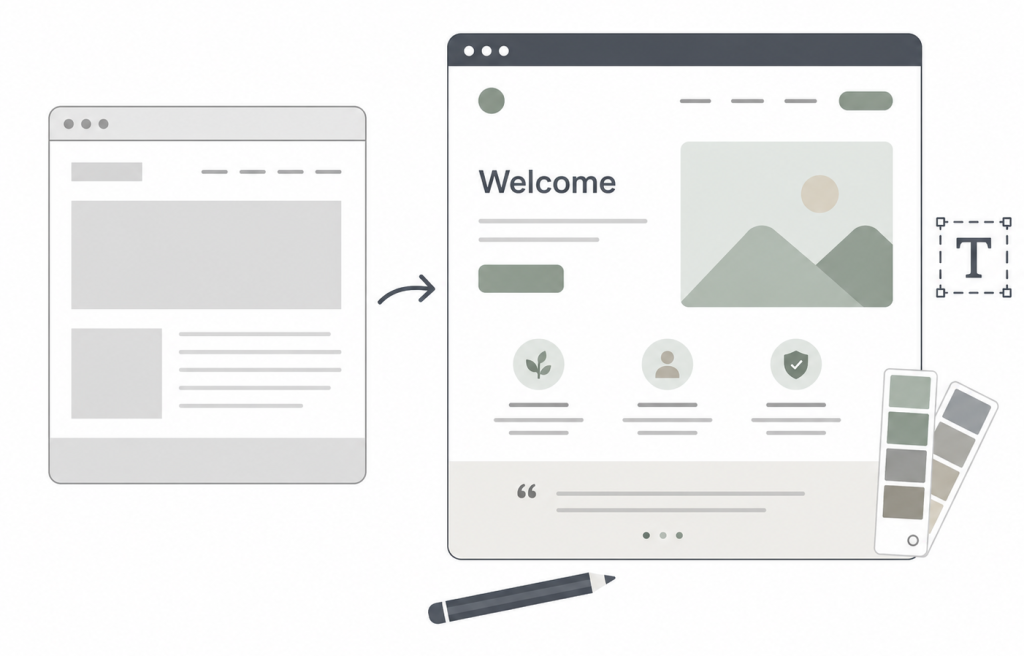
2. Performance problems keep coming back
Speed issues do not always call for a redesign. A lot can be fixed through optimization: infrastructure improvements, image compression, smarter caching, or code refinements. The picture changes when performance problems keep coming back despite repeated efforts to fix them.
In a lot of cases, recurring performance issues are symptoms of a deeper architectural limit rather than isolated technical faults. As a website evolves, new functionality gets added, integrations multiply, content libraries grow, and databases get larger. Each addition looks reasonable on its own, but together they raise the complexity of the whole system. Performance fixes provide temporary relief, but if the underlying structure never changes, holding onto consistent responsiveness gets harder and harder over time. In many cases, this is the visible result of accumulated technical debt. If a proper audit and several rounds of optimization have already been carried out and the site still underperforms, the underlying structure is likely the limiting factor.
This shows up most often in websites that have grown organically without any long-term technical strategy behind them. Eventually, keeping performance at an acceptable level takes more effort than it reasonably should. At that point, the conversation shifts away from optimization and toward whether the architecture itself has become the real constraint.
3. Content has become difficult to manage
One of the clearest signs a website may need rebuilding is when internal teams start struggling just to maintain it. Publishing content should not require deep technical knowledge, and routine updates should not feel risky or unreasonably time-consuming.
As a website grows, content structures that once felt adequate can start feeling restrictive. Teams end up duplicating pages because existing templates no longer fit new requirements. Information gets scattered across different sections, consistency gets harder to hold onto, and updates that should take minutes start eating up far more time than they should.
These problems go beyond operational efficiency. They tend to create inconsistencies in the user experience, make content harder to find, and limit how well the website can grow. A redesign gives an organization the chance to rethink content architecture, improve how things are organized, and build systems that stay manageable as content volume keeps growing.
4. Mobile experience has fallen behind user expectations
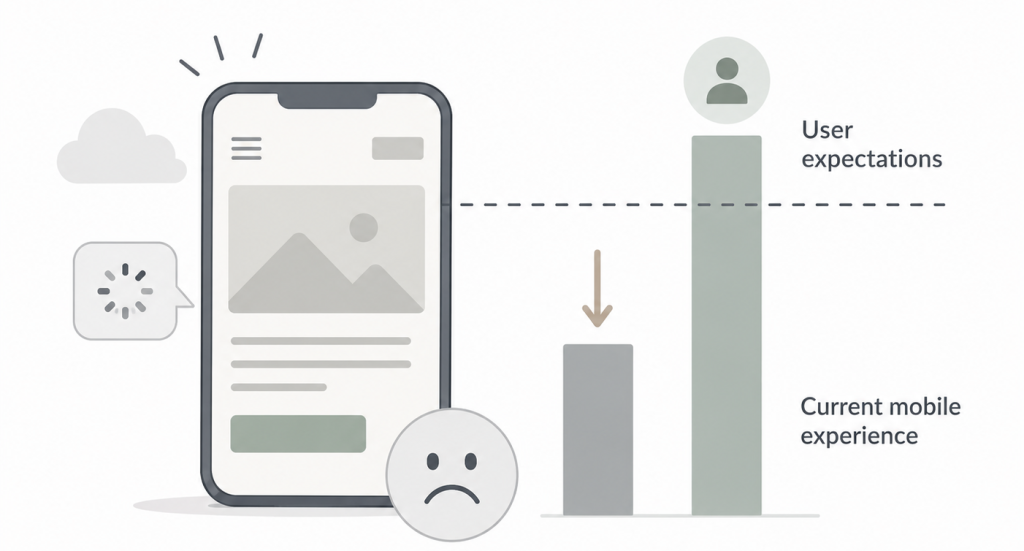
Most website traffic now comes from mobile devices, yet plenty of websites still carry design decisions that were made with desktop users in mind. Responsive layouts have become standard, but responsiveness on its own does not guarantee a good mobile experience. Navigation that works well on a large screen can feel clumsy on a phone. Content layouts that look balanced on desktop can feel overwhelming on a smaller screen. Forms that are simple on a laptop can turn frustrating on a touchscreen.
As expectations keep evolving, mobile experience plays a bigger role in engagement, conversions, and search visibility than it used to. When mobile usability problems affect large parts of a website, fixing them piece by piece is often less effective than rebuilding around a genuinely mobile-first approach.
5. New requirements are becoming harder to implement
A website should make growth easier, not harder. When every new initiative feels harder to implement than the last, that usually means the platform has hit the limits of its current structure. This shows up in different ways: marketing teams struggling to launch campaigns without developer help, new service offerings that do not fit naturally into the existing content structure, or integrations with CRM platforms, analytics tools, or automation systems that require increasingly complicated workarounds. For businesses running on hosted website builders, that ceiling is the platform itself rather than any particular design or content choice and the path forward often involves migrating to a more flexible foundation.
The issue is rarely the new functionality itself. More often, it is a sign that the website was designed around assumptions that no longer match current business needs. Over time, those limitations create friction that affects both day-to-day efficiency and future growth. A redesign gives an organization the chance to revisit those assumptions and build a platform around where the business is going, rather than where it used to be.
6. Security and maintenance keep getting harder
Every website needs ongoing maintenance: software updates, plugin reviews, backup testing, and regular security checks. These tasks are usually straightforward on a well-organized, actively maintained site. Problems tend to show up when routine work starts feeling risky, and even minor updates start feeling more complicated than they should.
Older websites tend to build up technical debt gradually rather than through one major failure. Plugins stay active because nobody fully remembers what they were for anymore. Custom functionality gets harder to touch because the documentation never kept up. Software updates get delayed because teams worry about unintended side effects elsewhere in the system. Over time, this creates an environment where maintaining the site demands more and more effort while confidence in making changes keeps dropping.
As complexity builds, maintenance shifts from a proactive activity focused on improvement into a reactive one focused purely on avoiding risk. Teams end up spending more time trying not to break things than actually improving the platform, which slows everything down and makes future changes harder still. In situations like this, a redesign offers a real chance to simplify the technical environment, cut unnecessary dependencies, and build a cleaner foundation that is easier to maintain, secure, and grow over the long term.
7. Your competitors have moved ahead
Competitor analysis should never be the sole reason to redesign a website, but it can offer useful context. Customers do not judge websites in isolation. Every digital experience they have shapes their expectations, including the experiences they have with competing organizations. If competitors consistently offer clearer navigation, better content experiences, stronger mobile usability, faster performance, or smoother customer journeys, that can be a sign your website is falling behind evolving expectations in your market.
This does not mean copying what competitors are doing. It means understanding how expectations are shifting and being honest about whether your current website is positioned to meet them.
Redesign or Optimization: How Do You Decide?
The decision comes down to whether the underlying architecture is still solid. If it is, and the problems are limited to specific areas like performance, design, or content quality, targeted improvements can often extend a website’s life significantly.
The decision gets more complicated once multiple problems start overlapping. A website struggling with recurring performance issues, difficult content management, structural limitations, maintenance headaches, and barriers to growth all at once may need more than incremental fixes. At that point, continuing to patch individual issues one at a time can become less efficient than addressing the root causes directly through a redesign.
The key question is not whether the website can be fixed. Most websites can be improved in some way. The more important question is whether those improvements actually solve the underlying problems, or just postpone them a little longer.
One of the most common mistakes organizations make is treating a redesign as a visual project rather than a business one. A new interface might look impressive, but if the underlying issues never get resolved, the same problems tend to come back within a few years. Successful redesigns start by understanding why the existing website is struggling in the first place. They look at user behavior, content structure, performance, maintenance needs, technical architecture, and business goals before any design decisions get made. That is what keeps the project focused on root causes instead of surface symptoms.
Done correctly, a redesign becomes more than a cosmetic refresh. It becomes a chance to build a platform that is easier to manage, better aligned with business goals, and genuinely capable of supporting future growth.
Frequently Asked Questions
- How do I know if my website needs a redesign or just an update? If the problems are limited to specific areas, like slow pages, outdated design, or disorganized content, targeted optimization usually solves it. A full redesign becomes the better option once several problems overlap at once and the underlying architecture itself is creating the friction.
- What are the most common signs a website needs to be rebuilt? The most common signs include a website that no longer reflects the business, recurring performance problems that optimization cannot fully resolve, content that has become difficult to manage, mobile usability that has fallen behind, new requirements that keep getting harder to implement, and maintenance that has become increasingly risky.
- Can website performance issues always be fixed without a redesign? Not always. Many performance issues respond well to optimization, such as caching, image compression, or infrastructure upgrades. When the same performance problems keep returning despite repeated fixes, that usually points to a deeper architectural limitation rather than something optimization alone can solve.
- Should a website be redesigned just because a competitor’s site looks better? No, that should never be the sole reason. Competitor comparison is useful context for understanding how user expectations are shifting, but a redesign decision should be based on whether your own website is genuinely holding the business back, not on appearance alone.
- How often should a business expect to redesign its website? There is no fixed timeline. A well-built website with flexible architecture can stay effective for many years with ongoing maintenance and incremental improvements. The need for a redesign depends on how well the platform keeps pace with the business, not on how much time has passed since launch.
Building Websites That Stay Effective Over Time
At Web Experts Nepal, we view website redesigns as opportunities to solve structural challenges, not just refresh a visual design. Every redesign service project that we engage in starts with understanding how the website currently performs, where the friction actually is, and what the organization needs from the platform going forward.
Those insights shape decisions around architecture, content structure, user experience, performance, scalability, and long-term maintainability. The goal is not just a better-looking website. It is a platform that stays reliable, adaptable, and effective as business requirements continue to change.
The most successful redesigns are rarely the ones that generate the most excitement on launch day. More often, they are the ones that keep supporting growth, improving efficiency, and delivering value years after they go live.
Contact UsRelated resources.
WordPress Security Checklist for Business Owners
Is Headless WordPress Worth It?
React for Product Development: When It Makes Sense and When It Doesn’t
Have an idea worth building?
Share your concept with us and we’ll help you shape the right approach.