
Many websites get built around launch day. The focus goes into finishing the design, publishing the content, and making sure everything works before the site goes live. Once the project ships, attention moves elsewhere until a problem shows up. For some organizations, that approach holds up fine for a while. For others, it leads to a familiar cycle: performance starts slipping, updates start feeling risky, new requirements take longer to implement than they should, and eventually the website feels like it is working against the business instead of for it.
The reality is that a website is not a finished product. It is an operational system that evolves alongside the organization running it. A company might launch new services, expand into new markets, run marketing campaigns, integrate new tools, or restructure how information gets presented. Every one of those changes touches the website in some way. The real question is not whether a website will change after launch. It is whether the website was built to absorb those changes without becoming progressively harder to manage.
That ability to stay reliable, adaptable, and maintainable over time is what actually makes a WordPress website sustainable.
A sustainable WordPress website is one built to handle change without becoming harder to manage over time. That depends on five things working together: architecture planned for future growth rather than just current requirements, performance treated as an ongoing process rather than a one-time launch task, security maintained through consistent review rather than a fixed setup, content structured to scale as volume grows, and hosting that grows alongside the business rather than staying fixed at the original package. Websites that get these right tend to avoid the expensive rebuild cycle that catches up with the ones that do not.
Sustainability starts with planning for change
Sustainability starts with planning for change because most long-term website problems trace back to a site built around today’s requirements instead of tomorrow’s.
At launch, the structure usually feels perfectly adequate. Navigation is clear, content is organized, and the functionality covers whatever the business needs right now. Problems tend to show up later, once the business starts asking the website to do more than it was originally built to handle. When the underlying architecture is rigid, even fairly small changes can turn into expensive projects. For businesses running on hosted website builders, that rigidity is built into the platform itself and migrating to WordPress is often how they regain the flexibility to grow
Sustainable WordPress development takes a different approach from the start. Rather than focusing only on immediate requirements, it leaves room for future growth. Content structures get designed to expand. Navigation systems can evolve without forcing a redesign. New functionality can go in without developers having to work around decisions made years earlier. That flexibility rarely comes from adding more complexity up front. More often, it comes from cutting unnecessary complexity and building a structure that is genuinely easier to extend later.
Performance is a long-term responsibility
That’s because slowdowns almost never come from one technical fault. They build up gradually from dozens of small additions that each seemed harmless on their own, a phenomenon most commonly known as technical debt. Most organizations only think about performance once they notice a problem: pages start loading more slowly, or users start reporting delays. A performance audit at that point often reveals issues that had been building for months without anyone noticing.
As a website matures, it naturally picks up additional weight in the form of new plugins, marketing tools, content libraries, and third-party services. None of these additions is inherently a problem, but every one of them adds work the website has to do. This shows up especially often in WordPress, since the platform makes it so easy to extend functionality. The same flexibility that makes WordPress appealing can also create long-term performance trouble if growth is not managed deliberately.
A sustainable website treats performance as an ongoing process rather than something checked off at launch. Performance reviews, plugin audits, database maintenance, image optimization, and infrastructure improvements all become part of regular operations instead of emergency fixes triggered after something breaks. Over time, this is what keeps a website responsive even as complexity keeps increasing.
Why does security depend on consistency rather than configuration?
Security depends on consistency because the environment around a website never stops changing, which means a site that was secure six months ago is not guaranteed to be secure today.
Security often gets treated as something solved through a one-time collection of settings. A website launches with security plugins installed, backups configured, and access controls in place, and the assumption becomes that the site is now secure, permanently. In practice, security behaves a lot more like ongoing maintenance than a configuration you set once.
Plugins receive updates. Team members gain or lose access. Third-party services integrated years ago keep evolving on their own. If routine maintenance and review have not kept pace with all of that, a site that once met a solid security standard can quietly fall behind it.
For WordPress websites, sustainability depends on building reliable processes around security rather than relying on a one-time setup. Keeping software updated is only part of the equation. Plugins need regular review, backup systems should be tested occasionally to confirm they actually work when needed, and user permissions should evolve as responsibilities shift inside the organization. These are small maintenance tasks individually, but together they prevent the kinds of issues that tend to go unnoticed until they become genuinely disruptive. Organizations that treat security as an ongoing responsibility tend to see far fewer disruptions than the ones that only react once something has already gone wrong.
Content structure matters more as websites grow
Content structure matters more as a site grows because a system that works fine for a few dozen pages tends to break down once volume increases without a clear framework behind it.
Without that framework, information gets harder to find, updates take longer to implement, and consistency starts slipping across the site. This is one of the reasons sustainable WordPress websites invest time in content architecture early. Categories, custom post types, reusable templates, and standardized content patterns all help maintain order as the site expands. Instead of building every page from scratch, teams work inside a system that keeps things consistent while staying flexible enough to handle new requirements as they come up.
A well-structured content model also tends to improve long-term search visibility, since it creates clearer relationships between topics, pages, and resources. For organizations publishing regularly, that becomes more valuable with every additional piece of content. For businesses serving customers in more than one language, that structure becomes even more critical—each language version needs to stay in sync with the primary, which requires a deliberate workflow and a clear picture of the ongoing cost.
Why should integrations support the website instead of controlling it?
Integrations should support a website rather than control it because the real risk is not connecting external tools, it is becoming tightly dependent on systems that keep changing on their own schedule.
Modern websites rarely operate on their own. They connect to CRM platforms, marketing automation tools, payment gateways, analytics systems, customer support platforms, and a growing list of other external services. These integrations often deliver real business value, but they can also introduce long-term complexity if they are not handled carefully.
A sustainable WordPress website is built so integrations can be updated, replaced, or expanded without forcing major structural changes elsewhere. That reduces operational risk and keeps the website from becoming more fragile every time a new system gets added. The more flexibility a business needs going forward, the more this principle matters.
Hosting decisions have long-term consequences
Hosting decisions carry long-term consequences because hosting often has more influence on a website’s sustainability than design, content, or functionality combined, even though it usually gets the least attention during a project.
A website that performs well early on can gradually get slower and less reliable as traffic grows, content expands, and new functionality goes in. In a lot of cases, the website itself is not the actual problem. The hosting environment simply has not kept pace with what is being asked of it.
Sustainable WordPress websites run on infrastructure that can grow alongside the business. That does not necessarily mean the most expensive hosting package available. It means choosing an environment that matches the site’s current needs while leaving room for what comes next, and revisiting that choice periodically rather than treating it as settled at launch. When infrastructure is properly matched to the website, performance tends to stay more stable, maintenance gets easier to manage, and scaling introduces far fewer surprises. An underpowered or poorly matched hosting environment, on the other hand, tends to become a recurring source of slowdowns and avoidable technical headaches that only get harder to fix the longer they go unaddressed.

How do sustainable websites improve over time?
Sustainable websites improve through ongoing observation and data rather than waiting for a redesign to feel necessary.
Many organizations eventually redesign their website because something just feels off: traffic plateaus, engagement drops, or the site starts to feel outdated. The trouble is that these decisions often get driven by assumptions rather than any real understanding of how people are actually using the site.
The most sustainable websites take a different path. Instead of waiting for frustration to build up, they use data to guide ongoing improvements. Analytics can show which content gets attention, where visitors drop off in key journeys, how people move through the site, and how those patterns shift as the business grows. That makes it possible to catch issues early and refine the experience continuously, rather than putting everything off until a major redesign becomes unavoidable.
Over time, a series of small, well-informed improvements tends to outperform a large overhaul carried out every few years. The website stays closer to real user behavior, and the organization gains a clearer picture of what is actually working and where it is not. Instead of starting over repeatedly, the platform evolves gradually, staying relevant and manageable as both user expectations and business needs keep shifting.
Building WordPress Websites for the Long Run
At Web Experts Nepal, WordPress is one of key service areas, so we treat websites built on it as long-term systems rather than short-term deliverables. That perspective shapes every stage of development, from planning and architecture to performance optimization, maintenance, and ongoing support. The goal is not simply to launch a website that performs well today, but to build one that stays reliable, efficient, and adaptable as business requirements change.
When sustainability is considered from the beginning, growth becomes easier to support, maintenance becomes more predictable, and the need for costly rebuilds becomes far less frequent. The most successful WordPress websites are rarely the ones that get the most attention at launch. More often, they are the ones built with enough flexibility and discipline to keep performing well years later.
Contact UsFrequently Asked Questions
- What makes a WordPress website sustainable in the long run? A sustainable WordPress website combines flexible architecture, ongoing performance maintenance, consistent security review, scalable content structure, manageable integrations, and hosting that grows with the business. It is the combination that determines whether a site stays manageable for years or needs a costly rebuild.
- Why do WordPress websites slow down over time even without major changes? Performance issues usually build up gradually from accumulated plugins, marketing tools, and third-party scripts added over months or years, rather than from one specific mistake. Each addition adds a small amount of load, and together they reshape how the site performs. This gradual build-up is the mechanism behind technical debt, and left unaddressed, it eventually forces either costly remediation or a full rebuild.
- Is a security plugin enough to keep a WordPress website secure? No. A security plugin is part of the picture, but the environment around a website keeps changing as plugins update, team access shifts, and integrated services evolve. Sustainable security depends on ongoing review, not a one-time setup.
- When should a business reconsider its WordPress hosting? Hosting should be reviewed periodically as the business grows, rather than treated as a decision made once at launch. If traffic, content volume, or functionality have expanded significantly since the original setup, the hosting environment may no longer match what the site actually needs.
- Does a sustainable WordPress website cost more to build initially? Not necessarily. Sustainability tends to come from reducing unnecessary complexity and planning content and architecture thoughtfully, rather than from spending more upfront. The cost savings usually show up later, in the form of fewer expensive rebuilds and less disruptive maintenance.
Related resources.
WooCommerce Store Speed Audit: Why Product Pages Slow Down As Your Catalog Grows
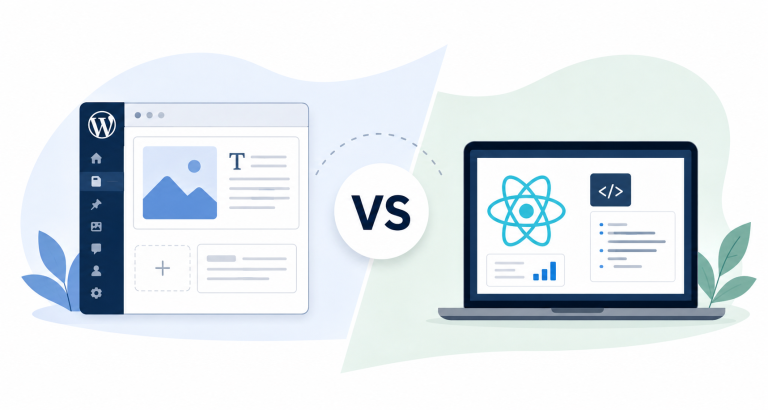
React vs WordPress: Which One Is the Right Choice for Your Website?

WordPress or Custom Development? A Practical Guide for Growing Businesses
Have an idea worth building?
Share your concept with us and we’ll help you shape the right approach.