

Business owners rarely doubt that outside developers can write good code. Instead, they worry about who makes the decisions once the work leaves the building. When an agency owns the plan, it also owns the daily choices about priorities, trade-offs, and quality. As a result, many owners have watched a budget shrink while a demo drifted away from what they wanted.
That outcome comes from one way of working. The provider owns the plan, and the client sees the result at the end. Team augmentation flips this arrangement. The plan stays with the client, so most of the risk disappears.
Team augmentation means adding outside developers to your own team. They work in your tools, follow your priorities, and send everything to your people for review before it goes live. The provider handles hiring, payroll, and equipment, but the direction stays with you.
When it comes to control, how is it different from outsourcing?
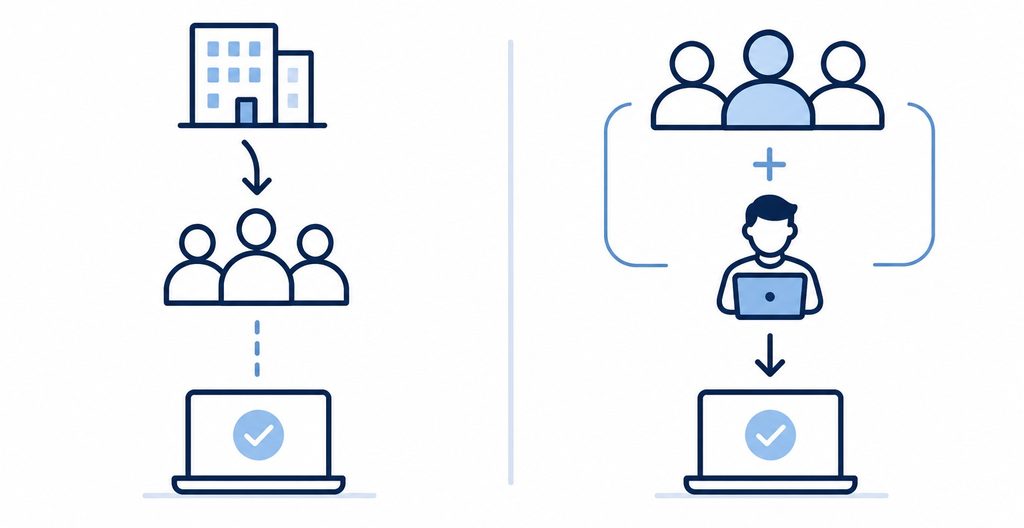
The difference comes down to who holds the plan. In traditional outsourcing, an agency takes on a project and organizes its own team. It then returns with a finished result. That suits a business that wants to hand something off completely. However, it also means the provider makes most of the daily decisions.
Team augmentation reverses this. The developers join your existing team, so decisions stay with the people who know your customers. Likewise, the work follows your calendar rather than the provider’s.
| Traditional Outsourcing | Team Augmentation | |
|---|---|---|
| Who directs the work | The provider | You |
| Workflow | Built around the provider | Built around yours |
| Communication | Usually through a project manager | Directly with your team |
| Changes in scope | Often renegotiated | Adjusted as priorities shift |
This model works best when you already know what needs building. Examples include an online store, a software product, or a company website that needs steady development work.
How much control do you keep day to day?
You keep the three decisions that matter most: what to build, in what order, and to what standard. There is enough flexibility for priorities to change from one week to another. For example, a developer can fix your online store checkout this week and start a new feature next week. You do not need to reopen a contract, because the work has no fixed project scope.
Standards work the same way. Developers adopt your review process, so your own people check their work before anything goes live. Likewise, they use the tools your team already knows, such as Jira, Trello, Asana, Slack, or Microsoft Teams. Nobody has to learn a new system.
Each task needs a clear purpose and a little background. Progress then shows up on your task board. As a result, you can see what is moving, finished, or stuck without asking for a status update. You get the same visibility you would have over an in-house employee.
Where things usually go wrong
There are many factors that may contribute to a project’s failure. In a team augmentation scenario, the usual point of failure is communication, not skill. A capable developer can lose a full day on the wrong task when a priority changes and nobody passes it on. For that reason, the best setups keep developers in the same channels as whoever sets direction. That person is often a technical lead or product manager. However, many growing businesses do not have one. In that case, WEN can add a team lead or project manager as an optional extra. This person turns business goals into clear tasks and keeps the work organized.

What happens if a developer is not the right fit?
A poor match is the risk that worries people most, so WEN designed the service around it. First, WEN sends a shortlist within two business days. Each developer has already passed a technical assessment. beforehand Then you interview the candidates and make the final choice.
If someone is still the wrong match, WEN replaces them within seven working days at no extra charge. Meanwhile, named backups keep the work moving if a developer leaves. As a result, a poor hire becomes a short interruption instead of a second recruitment campaign. You can see the full steps on our team augmentation service page.
Frequently asked questions
- How does the hiring process work?
You share the roles, technologies, and experience level you need. WEN sends matching profiles within two business days, and you interview the candidates and make the final choice. - What does the monthly fee include?
One developer starts from $3,500 per month. The fee covers wages, payroll, and equipment, so there are no recruiting fees to pay. - Will the developers work only on my projects?
Yes, plans are built around dedicated developers assigned to your team. - Can I start small and add more developers later?
Yes. Plans begin with one developer and have the option to grow to two, three, or more as your workload does. - Do the developers sign a confidentiality agreement?
Confidentiality terms are covered in the written service agreement. - Which technologies do the developers work with?
WEN developers work every day in WordPress, WooCommerce, React, and custom web builds.
Is Team Augmentation right for you?
The model suits businesses that can describe what they need built. It adds capacity without taking away your say in how the work gets done. Also, WEN has delivered more than 1,400 web projects since 2013, so the team knows this work well.
If you would like to talk it through, book a free consultation. WEN will recommend developers for your backlog, with no obligation. Meanwhile, if you are still deciding what to build on, our WordPress vs custom development comparison may help.
Contact UsRelated resources.

React for Product Development: When It Makes Sense and When It Doesn’t
React Development Process Explained: From Idea to Production

Custom Software vs. SaaS: When to Build Instead of Buy
Have an idea worth building?
Share your concept with us and we’ll help you shape the right approach.