
Every few months, a business comes to us having already made this decision and made it badly. Sometimes they have built a custom platform for what was essentially a brochure site, and they are now paying a developer to change a phone number. Other times, they have tried to run a complex booking and membership system through WordPress plugins, and the thing is held together with digital duct tape.
Both situations are avoidable. But avoiding them requires being honest about what your website actually needs to do, not what sounds most impressive in a planning meeting.
WordPress is the right foundation for most content-driven, marketing-focused websites. Custom development makes sense when the website needs to function as a software product, with complex workflows, deep integrations, or application-level logic that a CMS cannot support without significant compromise.
Everything below explains how to tell which situation you are in.
First, what are we actually comparing?
WordPress is an open-source content management system that powers around 43% of all websites on the internet. That scale reflects how well it solves the core problem most organizations face: giving non-technical teams the ability to publish and update content without relying on a developer for every change. Beyond content management, WordPress can be extended through plugins and custom development to support a wide range of additional functionality, from ecommerce via WooCommerce to membership platforms and booking systems.
Custom web development means building a system from scratch, designed specifically around the requirements of the business. The technology stack varies by project, but the defining characteristic is always the same: the product is built for the organization rather than adapted from a general-purpose platform. This approach is typically used for SaaS products, marketplaces, customer portals, and other web applications where the functionality is too specific or too complex for an existing platform to handle well.
The reason this decision matters is that websites rarely stay the same after launch. A platform that handles today’s requirements comfortably may become a source of friction as the business grows. Getting the initial choice right reduces the likelihood of an expensive rebuild further down the road.
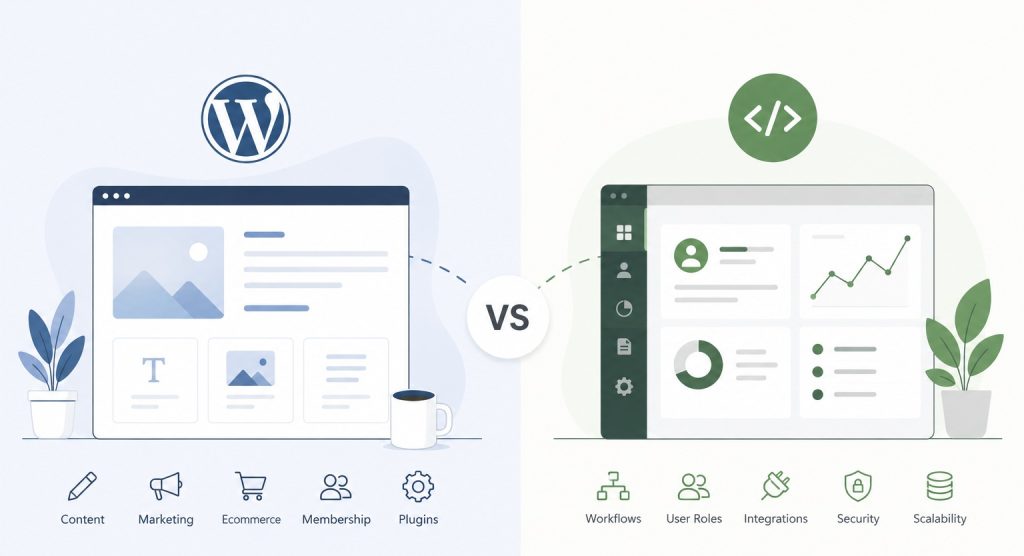
Quick comparison: WordPress vs. Custom development
WordPress tends to be the right call when:
- The site is primarily focused on content, marketing, or lead generation
- Non-technical staff need to manage and update it without developer support
- Getting to market quickly matters
- Budget efficiency is a genuine constraint
- You are building an ecommerce store on WooCommerce
Custom development tends to make more sense when:
- The site functions more like an application than a content platform
- Workflows are genuinely unique and represent a competitive advantage
- Deep integrations with other business systems are required
- Off-the-shelf platforms cannot meet the requirements without significant workarounds
- You are building a product that will grow and evolve substantially over time
For businesses still running on hosted website builders like Wix or Squarespace, the question that comes first is whether professional development is warranted at all and what the signs are that a builder has started holding the business back.
Where WordPress excels for business websites
We work with a lot of marketing teams, and the single biggest advantage WordPress delivers is operational independence. When a campaign goes live, when a product line changes, when someone needs to publish a guide or update pricing, they just do it. No ticket raised, no developer in the loop, no waiting.
That independence is worth more than most businesses account for when evaluating platforms. The total cost of a website is not just the build, it includes every hour a team spends waiting on a developer to make a change that should take five minutes. This accumulation of shortcuts and deferred decisions is what eventually shows up as technical debt and understanding it helps set more realistic expectations for long-term maintenance budgets.
Beyond content management, WordPress has a mature ecosystem of plugins and integrations. The functionality a typical business website needs, including contact forms, SEO tools, analytics, page builders, and membership systems, already exists and works reliably. There is no need to pay for development work that has already been done. The same applies to multilingual support, where plugins such as WPML and Polylang handle translated pages, menus, and SEO labeling without custom development.
WordPress is particularly well suited to: marketing and lead generation websites, service and portfolio sites, company blogs and content hubs, WooCommerce-powered ecommerce stores, and membership sites where content publishing is central to the product.
When custom web development is the better investment
The clearest sign that a business has outgrown what a CMS can comfortably do is when they start describing their website as “almost like a system.” For instance, describing them as “booking platforms”, “SaaS products”, “online marketplaces”, “customer portals”, and “internal workflow tools”. These are not websites that happen to have some features but rather they are web applications that happen to run in a browser. At this stage, the question shifts from which platform to use to whether building something custom is genuinely warranted—a decision that depends on the cost of current workarounds, the business uniqueness of the requirement, and whether the problem will scale.
Building those things in WordPress is not impossible but the further you push a CMS beyond its intended purpose, the more the platform starts working against you. Plugin conflicts accumulate. Performance degrades. Each update introduces risk. What felt like a practical shortcut at the start gradually becomes a drag on the development team and a ceiling on what the product can do.
Custom development makes sense when the system logic is genuinely complex, when workflows are specific enough that no existing plugin handles them properly, or when the product needs a technical foundation capable of supporting significant growth. The upfront investment is higher: more planning, more development time, more infrastructure consideration before anything goes live. For the right project, that investment pays for itself. For the wrong one, it is over-engineering that could have been avoided.
Headless WordPress: the option most businesses overlook
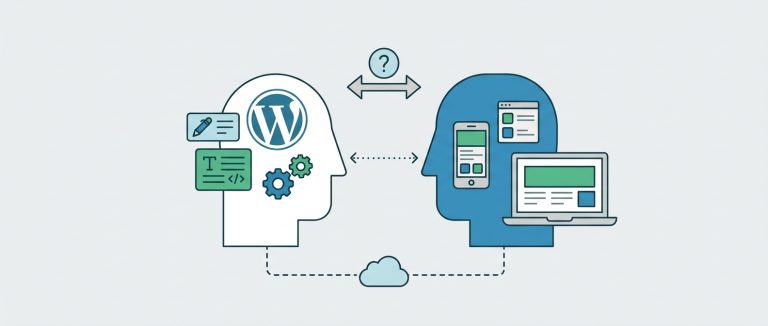
There is a third path that sits between a standard WordPress build and a fully custom system: headless architecture. In a headless WordPress setup, WordPress handles content management on the backend while a modern frontend framework such as React or Next.js controls what users actually see and interact with.
This approach has become increasingly practical over the last few years. The content team works in the WordPress editor they are already familiar with. The development team gets the architectural freedom to build fast, sophisticated frontend experiences without being constrained by WordPress’s templating system. It is a setup that works particularly well for businesses that need strong content management alongside more advanced digital functionality.
Headless WordPress does add complexity and cost compared to a standard WordPress build. It is not the right choice for every project. But for businesses that have been treating it as an either-or decision between WordPress and custom development, it is worth understanding as a genuine third option.
How to think about cost
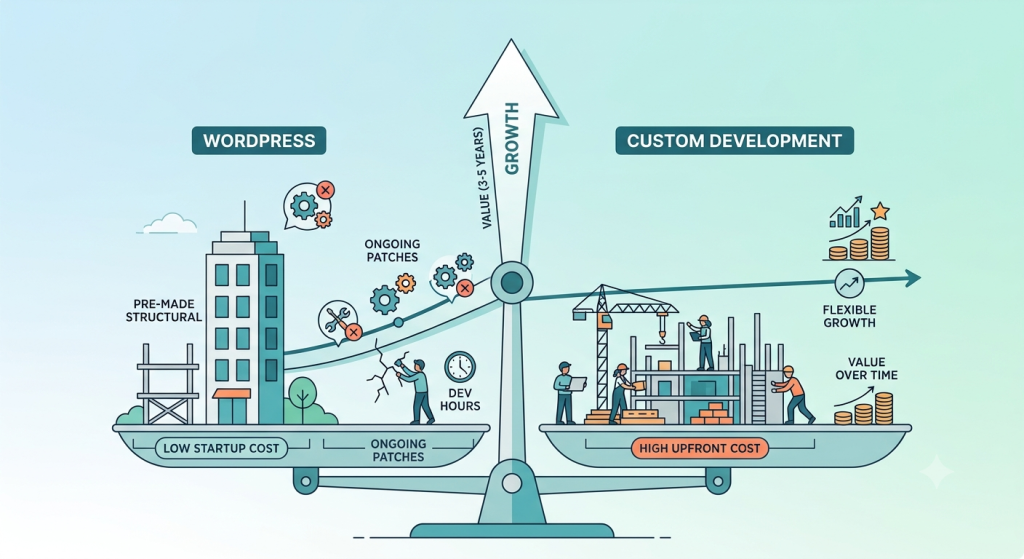
The upfront numbers are easy to compare. WordPress costs less to launch because much of the foundational work already exists. Custom development costs more because the team is building that foundation from scratch alongside everything else.
What is harder to see in advance is the longer-term picture. We have seen businesses spend years patching and working around a platform that was wrong for them from the start, and the accumulated cost in developer hours, lost efficiency, and missed opportunities ended up far exceeding what the right solution would have cost. The reverse is also true. Some businesses invest in custom development for requirements that a well-configured WordPress site would have handled without difficulty.
The more useful question is not which option is cheaper. It is which option creates more value over the next three to five years given what the business is actually trying to build.
WordPress scalability: what is and is not true
WordPress gets dismissed on scalability more than it deserves. A properly architected WordPress site with good hosting, sensible structure, and sound performance practices can handle substantial traffic and support a business through years of growth. The platform is not usually the bottleneck; poor implementation is.
That said, there are genuine limits. Systems that require real-time data processing, highly complex user interactions, or application-level backend logic will eventually hit constraints that WordPress cannot solve regardless of how well it is configured. When that is the situation, a purpose-built system is not a luxury. It is simply the appropriate tool for the job.
Decision matrix
| Requirement | WordPress | Custom Development |
|---|---|---|
| Faster launch timeline | ✓ | |
| Lower upfront investment | ✓ | |
| Easy content management | ✓ | |
| Flexible content publishing | ✓ | |
| Marketing-focused websites | ✓ | |
| Highly unique functionality | ✓ | |
| Complex workflows | ✓ | |
| SaaS or web applications | ✓ | |
| Full architectural control | ✓ | |
| Advanced digital products | ✓ | |
| Hybrid / headless architecture | ✓ | ✓ |
How to actually make this decision
Stop asking which platform is better in general. Start asking what your website needs to do, not just now but in two or three years if the business grows the way you expect it to.
If the answer is primarily content, marketing, and giving a non-technical team the ability to keep things current, WordPress is the more practical and cost-effective foundation. If the answer involves application logic, specialized workflows, or a product that is going to evolve significantly, you need a foundation that can support that from the start.
One thing worth knowing: the initial choice is not permanent. Many businesses start on WordPress and migrate to a custom or hybrid architecture later as their needs grow beyond what the platform can support. Starting on the right platform simply means that transition happens on your terms rather than under pressure.
Frequently Asked Questions
- Is WordPress good enough for a professional business website?
Yes, for most businesses. WordPress powers a significant proportion of the web including large media organizations, enterprise marketing sites, and major ecommerce operations. Whether it is the right choice depends on what the site needs to do, not on the platform’s general reputation. - How much does custom web development cost compared to WordPress?
Custom development carries a higher upfront cost because the foundational work is being done from scratch. A WordPress project can often be delivered for significantly less at launch. Over time, the total cost of ownership depends on factors like maintenance requirements, the need for ongoing development, and whether the platform can support growth without architectural changes. - What is headless WordPress?
Headless WordPress is an architectural approach where WordPress is used only as a content management system on the backend, while a separate frontend framework such as React or Next.js handles the user-facing experience. It allows businesses to retain WordPress’s content management capabilities while building more sophisticated and performant frontend experiences. - When should a business choose custom development over WordPress?
Custom development is generally the better choice when the website needs to function as a software product rather than a content platform. If the core requirements involve complex application logic, specialized workflows, or deep integrations that existing plugins cannot handle well, custom development is likely to be more practical in the long run. - Can a WordPress site be converted to a custom-built system later?
Yes. Many businesses start with WordPress and move to a custom or headless architecture as their requirements become more complex. Planning for this possibility during the initial build can make that transition easier when the time comes.
Work with us
At Web Experts Nepal, we help businesses work through this decision based on what they are actually building, not on general assumptions about which platform is better. Regardless of what the right answer is, we focus on building something designed to support long-term growth rather than just the immediate requirement.
If you are working through this decision and want a practical conversation about which direction makes sense, we are happy to provide our expertise both WordPress and customer web development services to help you choose better.
Contact UsRelated resources.
Is Headless WordPress Worth It?
Migrating From Wix or Squarespace to WordPress: A Practical Guide
Next.js vs React: What Is The Difference And Which Should You Choose?
Have an idea worth building?
Share your concept with us and we’ll help you shape the right approach.