

Launching an online store has never been easier. Businesses today can choose from dozens of eCommerce platforms, each promising to help them sell more, streamline operations, and grow faster. Options range from all-in-one hosted solutions to open-source platforms and fully custom builds, so the choice is wider than it has ever been.
The thing is, more options do not necessarily make the decision easier. The eCommerce platform you select becomes the foundation of your online business. It shapes how you manage products, process orders, optimize for search engines, integrate with other systems, and adapt to changing customer expectations. Choosing the wrong platform can lead to unnecessary costs, technical limitations, and even a complete rebuild once your business outgrows it. When that moment arrives, the decision is rarely as simple as choosing the next platform—it often involves evaluating whether custom development would serve the business better than another off-the-shelf solution.
Given these stakes, there is no single platform that works for every business. Instead, the right eCommerce platform depends on your goals, budget, operational needs, and long-term plans. This guide walks you through the key factors to weigh, compares the main types of solutions available, and answers the questions most businesses ask before committing to a platform.
Why your platform choice matters
An eCommerce platform is far more than a place to list products. It influences nearly every part of running an online business, including customer experience, product and inventory management, payment processing, shipping, marketing, SEO, security, site performance, growth, and integration with CRM, ERP, and accounting software.
Because it touches so much of the business, changing platforms later is possible but rarely simple. It usually means migrating products, customer data, order history, content, and SEO assets all at once, so getting the decision right from the start will save you considerable time and cost down the road.

Step 1: Define your business goals
Before comparing features or pricing, clarify what your business actually needs. Ask yourself: What products or services will you sell, and how many do you have today? How quickly will your catalogue grow? Will you sell internationally, or offer subscriptions and memberships? Will your site include blogs or educational content? Do you need integration with other business systems you already use? While the bigger questions about long-term growth may not be answered straight away, especially when you are just starting out, they are important points to consider right from the get-go.
For example, a small boutique selling handcrafted goods has very different requirements from a wholesaler managing thousands of SKUs (stock keeping units) or a nonprofit selling event tickets and merchandise. Let your business model guide the decision, not the latest technology trend.
Step 2: Understand the main types of eCommerce platforms
Most products on the market fall into three broad categories.
Hosted platforms, such as Shopify, offer an all-in-one solution. The platform manages hosting, security, updates, backups, and core infrastructure, so you can launch quickly without running your own servers. Hosted platforms suit organizations that value simplicity and speed, though the trade-off is less flexibility and greater dependence on the platform’s ecosystem.
By contrast, open-source platforms, such as WooCommerce, give you full ownership of your site, along with more customization, more integration options, and the freedom to choose your own hosting provider. They generally require more technical involvement, but provide far greater flexibility as requirements evolve.
For businesses that outgrow both options, custom eCommerce development suits organizations that need functionality no existing platform can deliver. It offers maximum flexibility, but comes with higher costs, longer timelines, and more maintenance responsibility. Most businesses, though, find that modern platforms already provide more than enough capability without a custom build.
Step 3: Consider ease of use
A successful online store depends not just on the customer experience, but on how easily your team can manage it day to day. Can staff add products without developer help? Is inventory management straightforward, and can you update prices or launch promotions quickly? Are reports easy to interpret without training?
If a platform requires a developer for routine updates, it can become expensive and slow over time. The best platform is usually the one your team can confidently run after launch.
Step 4: Plan beyond today’s requirements
Many businesses choose a platform based only on their current needs. A better approach is to consider where the business will be in three to five years. Will your product range expand significantly? Will you need multiple warehouses, wholesale pricing, or international sales? Will customer accounts need to become more sophisticated, or will you require additional integrations down the line?
Choosing an ecommerce platform that can grow with you now can prevent a costly migration later, so weigh future scale alongside your present needs.
Step 5: Assess customization and flexibility
Every business runs on its own processes. Some need advanced shipping rules; others need customer-specific pricing, subscriptions, product bundles, or a custom checkout experience. Check whether a platform lets you modify workflows, add custom functionality, build unique customer experiences, and integrate external systems without hitting a wall.
Over time, though, a platform that looks simple today may become restrictive as your business evolves, so test its limits before you commit, not after.
Step 6: Review integrations
Most online stores rely on several other business systems, including CRM, accounting software, ERP, inventory management, email marketing, shipping providers, payment gateways, and analytics tools. Strong integration capabilities reduce manual work and improve efficiency, since the fewer times staff re-enter the same data across systems, the less time and accuracy you lose to errors.
Step 7: Understand the total cost of ownership
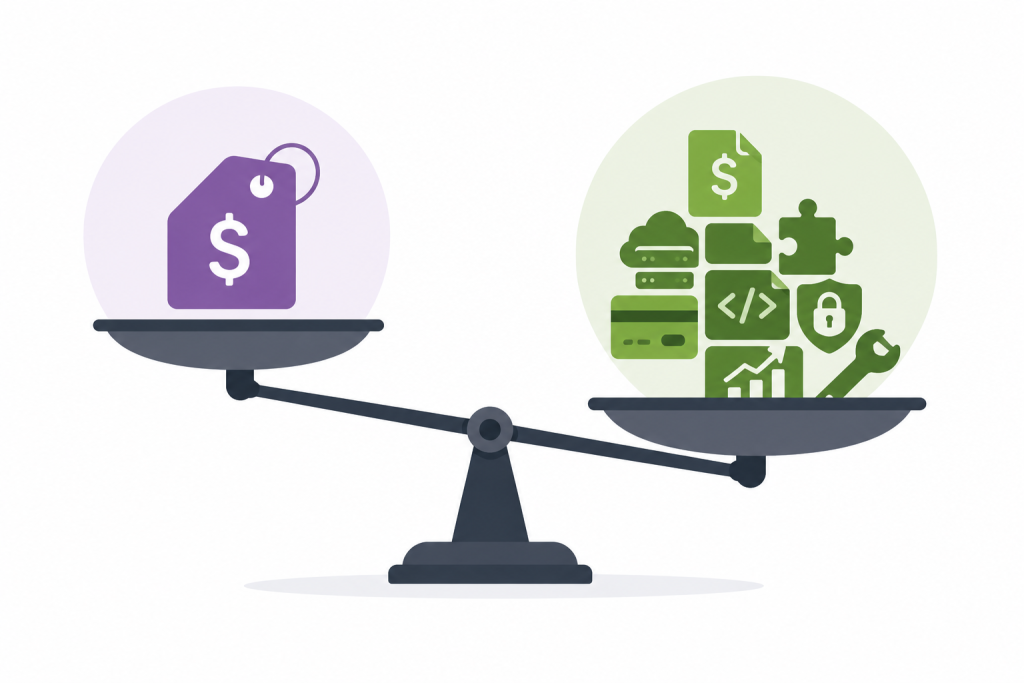
Many businesses compare only subscription prices, but that rarely reflects the true cost. Factor in platform licensing, hosting, premium plugins or apps, payment gateway fees, development, maintenance, security, and future upgrades.
In fact, the cheapest platform at launch can become the most expensive within a few years if it demands extensive workarounds or third-party apps to do what you need. Look at the total cost of ownership rather than the sticker price alone.
Step 8: Prioritize security and reliability
Customers trust online stores with personal and financial information, so security should be a core evaluation criterion, not a checkbox. Look for SSL support, regular updates, secure payment processing, permission management, backups, and active security monitoring.
Reliability matters just as much, since downtime directly affects revenue and customer trust. Whether you choose a hosted platform or an open-source solution, make sure the underlying infrastructure can deliver consistently dependable performance.
Frequently Asked Questions
- What is the best eCommerce platform?
There is no universally best platform. The right choice depends on your products, business model, budget, technical resources, and long-term goals. - Which eCommerce platform is best for SEO?
Platforms with strong technical SEO and content management generally perform best. WooCommerce is widely recognized for its flexibility, since it combines eCommerce functionality with WordPress, a leading content management system. - Should you choose WooCommerce or Shopify?
If you prioritize simplicity and fast setup, Shopify is often the better fit. If you want greater customization, full ownership, and long-term flexibility, WooCommerce tends to serve you better. Base the decision on your requirements rather than which platform is more popular. - Can you change platforms later?
Yes, though migrating products, customer accounts, orders, and SEO assets requires careful planning. Choosing the right platform from the start is usually more cost-effective than migrating later. - Is a custom eCommerce platform worth it?
Only in specific circumstances. Most businesses can meet their goals on established platforms without the added cost and maintenance of custom development.
Choose a platform that supports your business, not just your website
The best eCommerce platform is rarely the one with the longest feature list or the lowest monthly fee. It is the one that aligns with your business strategy, supports your operations, and leaves room to grow without adding unnecessary complexity.
In practice, some businesses benefit from the simplicity of a hosted platform like Shopify. Others gain more long-term value from the flexibility and ownership WooCommerce offers. Larger organizations with specialized requirements, meanwhile, may need an enterprise platform or a custom build instead.
Given all this, instead of asking, “Which platform is best?” ask, “Which platform fits how our business operates today, and where we want it to be in the future?” Answering that question can save you considerable cost and give your business a stronger foundation for long-term growth.
At Web Experts Nepal, we help organizations evaluate eCommerce platforms based on their business objectives rather than technology trends. Whether you are launching your first online store, planning a migration, or expanding an existing operation, choosing the right platform is one of the most important decisions in the project. A thoughtful evaluation at the outset helps your website support the business well beyond launch day.
Contact UsRelated resources.
HubSpot and WordPress: How To Connect The Two Platforms The Right Way
React Development Process Explained: From Idea to Production
What You Should Know About Headless CMS Platforms
Have an idea worth building?
Share your concept with us and we’ll help you shape the right approach.