
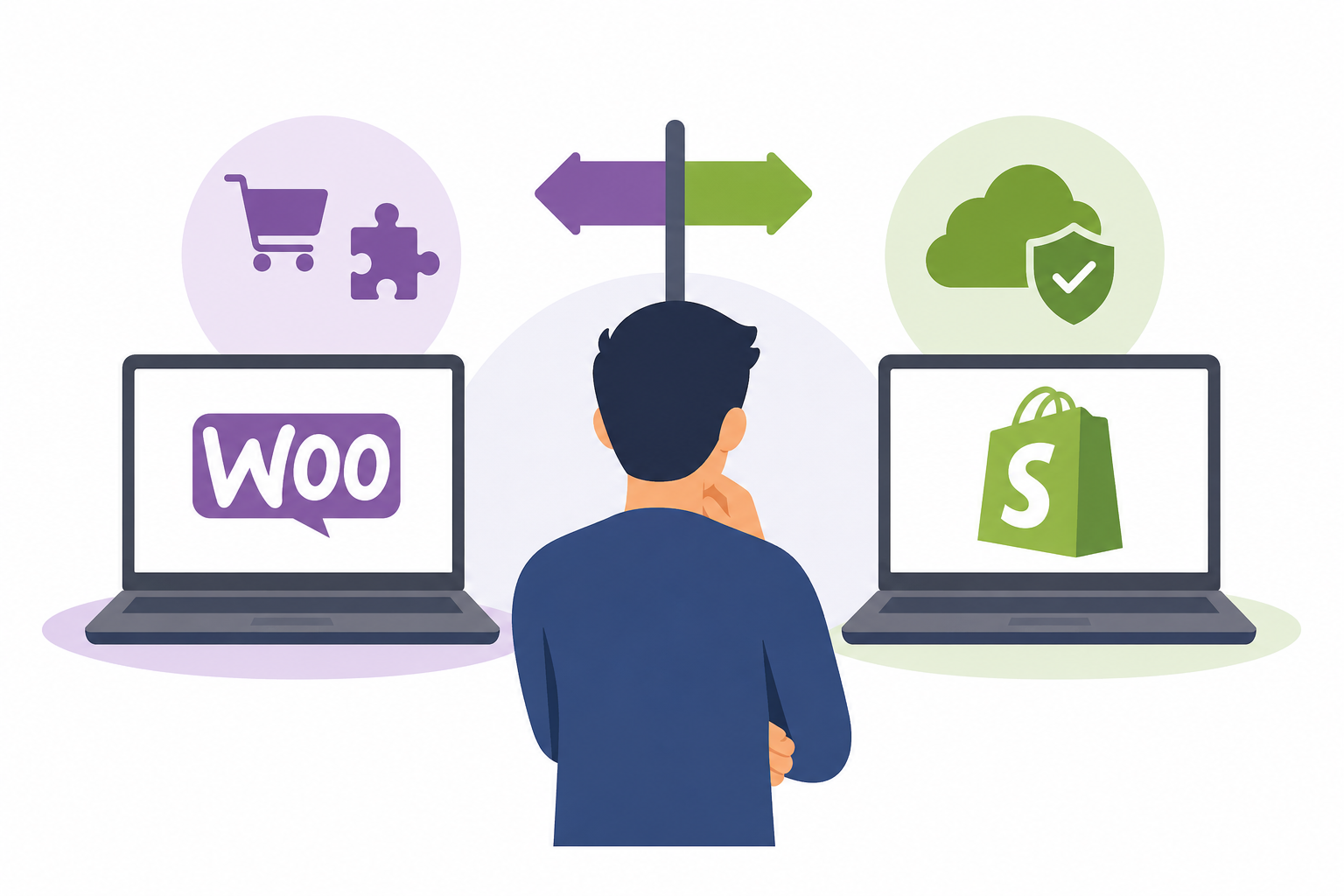
Choosing an eCommerce platform is one of the most consequential decisions you will make when launching or expanding an online store. It shapes far more than how your website looks: your choice affects operating costs, customization options, search visibility, integrations, scalability, and how much control you retain over your own business.
Two platforms dominate this conversation: WooCommerce and Shopify. Both power millions of stores worldwide and have loyal advocates, yet they are built on very different philosophies. The right choice depends on your goals, technical resources, growth plans, and how much flexibility you expect to need in the years ahead.
This guide compares WooCommerce and Shopify across the factors that matter most, so you can decide which platform fits your business.
WooCommerce vs Shopify at a glance
| Feature | WooCommerce | Shopify |
|---|---|---|
| Platform type | Open-source plugin for WordPress | Fully hosted SaaS platform |
| Setup | Moderate | Very easy |
| Monthly fees | Flexible, pay for what you use | Fixed subscription |
| Hosting | You choose your provider | Included |
| Ownership | Full ownership | Platform-managed |
| Customization | Extensive | Moderate |
| SEO and content | Excellent | Good |
| Maintenance | Your responsibility | Managed by Shopify |
| Best suited for | Businesses wanting flexibility and long-term control | Businesses wanting simplicity and speed |
This table offers a useful starting point, but the right decision comes down to how you plan to operate and grow.
Understanding the core difference
At a high level, WooCommerce and Shopify solve the same problem: helping businesses sell their wares online. However, the difference is how much control each one provides to such a business.
Shopify provides a complete, managed ecosystem, including features like hosting, security, updates, and backups handled by the platform, so you can launch quickly without managing servers or software updates yourself. WooCommerce takes a different approach, built on the more widely used WordPress platform, as it lets you choose your own hosting provider, customize nearly every aspect of your site, integrate with almost any system, and retain complete ownership of your website and customer data.
A simple way to think about it: Shopify is like renting a storefront in a managed shopping mall, while WooCommerce is like owning your own building. Owning requires more responsibility, but you decide how everything works.

Ease of use
If you are launching your first online store, Shopify is generally easier to learn, since most technical tasks happen automatically and you can focus on products, orders, and marketing rather than website upkeep.
WooCommerce requires a bit more setup, since you need to configure hosting, install WordPress, and manage updates. That said, modern managed WordPress hosting has simplified this considerably, and once configured, WooCommerce feels familiar to anyone who has used WordPress before. The real difference is not difficulty so much as responsibility: Shopify manages much of the technical environment for you, while WooCommerce gives you greater control over it.
Pricing: Looking beyond the monthly fee
One of the most common questions business owners ask is whether WooCommerce is cheaper than Shopify. The honest answer depends on what you are comparing.
Shopify runs on a subscription model, with monthly fees typically ranging from $30 to a few hundred dollars depending on the plan. Those fees bundle hosting, security, and platform support, though standard plans also carry a transaction fee on top unless you use Shopify Payments, which is worth factoring into your total cost.
WooCommerce itself is free, but you will pay separately for hosting (often $10 to $50 a month for a small to mid-sized store, or more as traffic grows), a domain, any premium plugins or themes, and payment gateway fees. There is no bundled transaction fee simply for using WooCommerce, since it is not the payment processor.
For a small store, either platform can be cost-effective. As a business grows, Shopify stores often accumulate paid apps that add up over time, while WooCommerce needs a larger upfront investment in exchange for more freedom over where your money goes. Instead of asking which platform is cheaper in isolation, ask which one delivers better long-term value for how you plan to run and scale your store.
Customization and flexibility
No two businesses operate the same way as some need complex pricing tiers, others need membership systems, custom product configurators, wholesale pricing, ERP integrations, or highly tailored customer journeys.
This is where WooCommerce holds a clear advantage. Because it is open source, developers can customize nearly every part of the platform, and you are not limited to predefined workflows. Shopify also supports customization through themes and apps, but changes generally happen within its own ecosystem. For many businesses, that level of flexibility is more than enough. For organizations with unique operational requirements, however, WooCommerce typically offers considerably more room to build exactly what you need.

Apps, plugins, and integrations
Modern online stores rarely operate in isolation. Many need to connect with CRM platforms, inventory systems, accounting software, marketing automation tools, shipping providers, or ERP systems.
Both WooCommerce and Shopify support thousands of integrations, so the real difference is openness. WooCommerce’s open architecture lets you build custom integrations and adapt workflows to your existing operations, while Shopify’s ecosystem is extensive but more tightly controlled. For straightforward stores this may not matter much, but for businesses with complex operational processes, it can become a deciding factor.
Performance and security
Performance and security are often cited as reasons to choose Shopify, though the reality is more balanced. Because Shopify controls its own infrastructure, performance tends to be consistent out of the box. WooCommerce’s performance, by contrast, depends largely on implementation: a professionally built store with quality hosting, caching, image optimization, and a content delivery network can perform exceptionally well.
The same logic applies to security. Shopify manages much of it automatically, while WooCommerce requires ongoing updates, monitoring, backups, and adherence to best practices. Neither platform is inherently insecure; good implementation matters far more than the platform you choose.
Scalability
Can WooCommerce handle a growing business? Yes. Large stores with thousands of products and heavy daily traffic run successfully on WooCommerce every day, just as Shopify supports businesses ranging from start-ups to global brands. The difference lies in how each platform grows.
Shopify grows through increasingly capable managed services, while WooCommerce grows through flexible infrastructure that you control directly. If you expect your workflows to become more specialized over time, WooCommerce’s ability to evolve without platform-imposed limits is often the more appealing path. For stores building toward very large catalogues, WooCommerce’s path involves specific decisions around search indexing, product data structure, and filtering architecture that become critical before performance degrades
Which platform fits your business?
Consider WooCommerce if you want complete ownership of your website, expect your requirements to evolve, plan to invest heavily in SEO and content marketing, need custom functionality, want flexibility in hosting, require advanced integrations, or already use WordPress.
Consider Shopify if you want the fastest path to launching a store, prefer predictable monthly pricing, have limited technical resources, want maintenance handled for you, or have relatively straightforward requirements.
Neither choice is permanent as you are free to redesign your platform as your needs platform’s needs grow. Many businesses start on Shopify and later migrate to WooCommerce as their needs grow more sophisticated, while others remain on Shopify for years because it continues to meet their requirements effectively.
Frequently Asked Questions
- Which platform is better for SEO? Both support strong SEO practices, but WooCommerce generally offers greater flexibility because it is built on WordPress. If you plan to invest heavily in organic search, you will likely appreciate the added control over content structure and publishing workflows.
- Is WooCommerce cheaper than Shopify? WooCommerce has no licensing fee, but you will pay separately for hosting, maintenance, and optional extensions. Shopify bundles many of these into one subscription. Your overall cost depends on the complexity of your store and the features you need.
- Is Shopify easier to use? For most beginners, yes. Shopify is designed to simplify setup and ongoing maintenance, while WooCommerce involves more initial configuration but rewards you with greater flexibility.
- Can WooCommerce handle large online stores? Yes. With the right hosting and optimization, WooCommerce supports large product catalogues, high traffic volumes, and complex integrations without difficulty.
- Can you migrate from Shopify to WooCommerce? Yes. Products, customer accounts, and order history can usually be migrated, though complexity depends on the size of your store and any custom functionality that needs to be rebuilt.
The best platform is the one that fits your business
The WooCommerce versus Shopify debate often centers on features, pricing, or popularity, but successful eCommerce projects are built around business strategy rather than platform comparisons. The right platform should support how your business operates today while leaving room to adapt as your needs change.
For many businesses, Shopify delivers exactly what they need: a reliable, easy-to-manage store with minimal technical overhead. For others, WooCommerce’s flexibility, ownership, and ability to integrate deeply with broader digital ecosystems make it the stronger long-term investment. The right answer is not the platform with the longest feature list. It is the one that aligns with your goals, your workflows, and your plans for future growth. For businesses whose requirements have grown complex enough that neither platform fits without significant workarounds, the question shifts from which ecommerce platform to choose to whether building something custom is actually warranted.
At Web Experts Nepal, we help businesses evaluate eCommerce platforms based on practical requirements rather than marketing claims. Whether you are launching your first store, planning a migration, or improving an existing one, choosing the right platform early can prevent unnecessary costs and technical limitations later.
Contact UsRelated resources.

Why Your Website Is Slow (And What to Do About It)

Legacy Website Modernization Guide: How to Upgrade Without Starting From Scratch
React 19: What Is New, What Has Changed, and Should You Upgrade?
Have an idea worth building?
Share your concept with us and we’ll help you shape the right approach.