
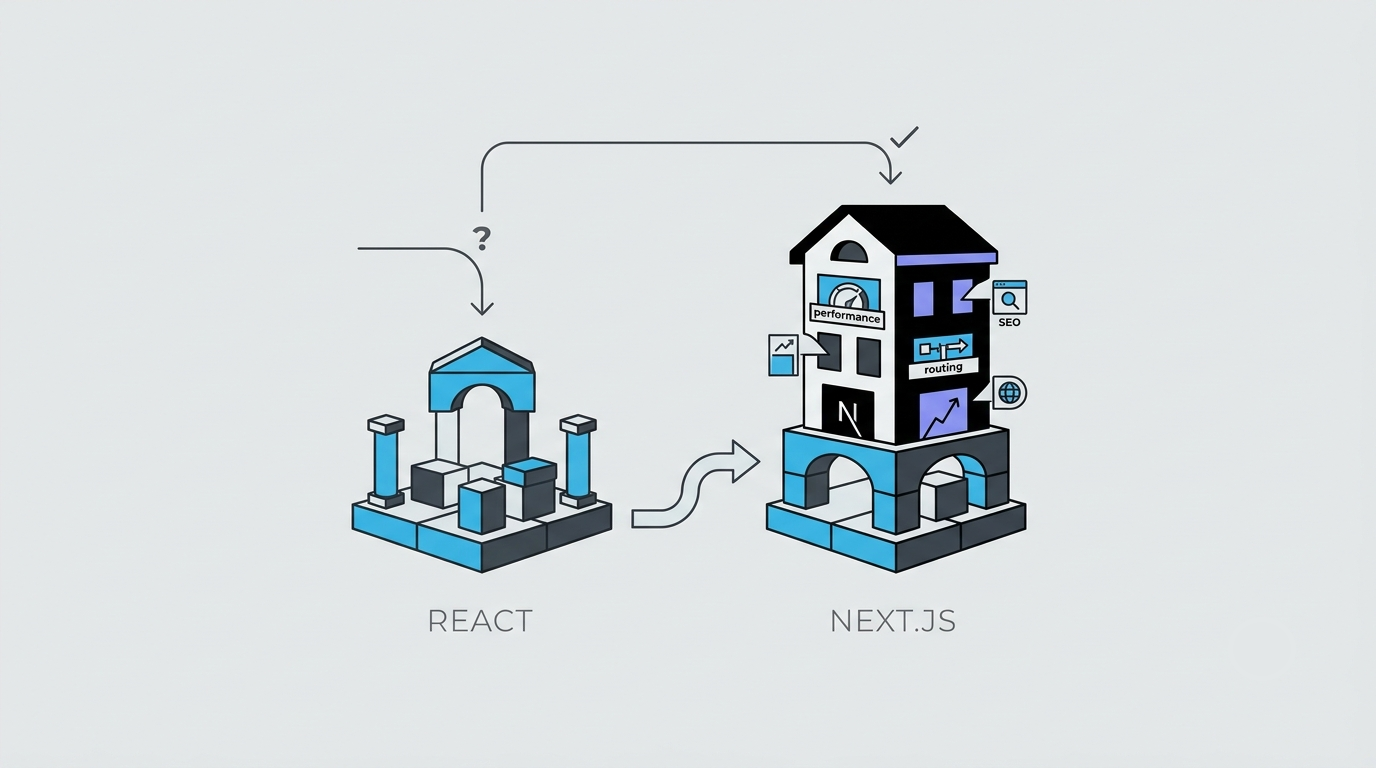
Pick the wrong foundation for a web application, and a business can spend months untangling the mistake later. This is why the React versus Next.js question comes up so often, and why so much of the advice online gets it wrong. Some articles frame the two as competing technologies, while others claim Next.js has quietly replaced React altogether. Neither claim holds up.
In short, React is a JavaScript library for building interfaces, and Next.js is a framework built on top of React that adds the routing, rendering, and performance features most real applications need. The comparison, therefore, is less “A versus B” and more a building material versus the finished structure built from it. Understanding this relationship makes it easier to choose the right foundation, whether the project is a start-up MVP, an enterprise platform, or a customer-facing SaaS product.
What Is React
React is an open-source JavaScript library, created by Meta, for building interactive user interfaces. It handles the rendering of components such as dashboards, forms, product pages, navigation menus, and chat interfaces, and it popularized reusable UI components, which made large applications considerably easier to build and maintain.
However, a typical React application runs inside the browser, where JavaScript downloads first and renders the page afterward. React itself focuses purely on the interface layer. It does not include routing, server-side rendering, API handling, authentication, image optimization, or SEO tooling, so developers add separate libraries whenever these features become necessary.
What Is Next.js
Next.js is a full-stack React framework, created by Vercel, that extends React with the features most production applications eventually need. Rather than replacing React, it builds on top of it, bundling together the tools developers would otherwise have to add one by one: automatic page routing, server-side rendering (generating the page on the server before it reaches the browser), static page generation for content that rarely changes, built-in API support, image and font optimization, and metadata handling for search engines. Instead of assembling these pieces from separate libraries, teams get an opinionated structure that solves many common development challenges out of the box.
The Core Difference Between Next.js And React
React builds user interfaces, while Next.js builds complete web applications on top of those interfaces using React as its foundation. In practice, React gives developers freedom to assemble their own architecture, whereas Next.js provides that architecture already in place. Neither approach is inherently better; the right choice depends on how much structure a project needs from the outset, a question that comes up just as often when comparing React against WordPress for a new build.
| Feature | React | Next.js |
|---|---|---|
| UI Components | Yes | Yes |
| Built on React | — | Yes |
| Routing | External library required | Built in |
| SEO Support | Limited | Strong |
| Server-Side Rendering | Requires setup | Built in |
| Static Site Generation | Requires setup | Built in |
| API Routes | Not included | Included |
| Image Optimization | Not included | Included |
| Full-Stack Development | Not included | Included |
| Deployment | Flexible, manual setup | Streamlined |
Performance Comparison
Beyond the feature checklist, the two approaches diverge most clearly once real traffic hits the application. Performance ultimately depends on how an application is built rather than which technology it uses, though the underlying factors that shape website performance apply regardless of framework. A standard React application typically downloads its JavaScript first, renders content in the browser, and loads additional data afterward, which suits highly interactive interfaces but can delay the first meaningful content a user sees. Next.js, meanwhile, improves loading through server-side rendering, static generation, automatic code splitting, image optimization, and streaming, often lifting Core Web Vitals, the loading-speed and stability scores Google uses to judge page quality, without significant custom engineering. For teams without dedicated performance specialists, this built-in advantage can matter more than raw framework speed.

SEO And Search Visibility
Beyond loading speed, search visibility is another area where the two diverge sharply. Traditional React applications rely heavily on client-side rendering, and while search engines have become better at processing JavaScript, server-rendered HTML remains easier and faster for crawlers to index. Consequently, Next.js generates HTML before users even arrive, supporting faster indexing, richer metadata, better social sharing previews, and stronger Core Web Vitals overall. This is one of the main reasons content-driven and customer-facing websites tend to favor Next.js over plain React.
Developer Experience And Learning Curve
React offers considerable flexibility, since it pairs with virtually any routing, state management, backend, or deployment solution. That flexibility is powerful, though it also puts more architectural decisions on the development team. Next.js reduces this burden through sensible conventions, freeing developers to spend less time on infrastructure and more time on product features. Learning React first still makes sense for anyone new to the ecosystem, since Next.js builds directly on its concepts. For businesses evaluating a technology partner, however, the outcome matters more than the learning curve, and most modern teams now choose Next.js directly for new production applications because it applies many best practices automatically.
Choosing Between React And Next.js
React alone remains a strong choice for applications where search visibility is not a priority and the interface leans heavily interactive. Internal business dashboards, CRM systems, admin portals, and analytics tools fall into this category, since these products are typically used behind a login and depend on dynamic interaction rather than public discoverability.
Next.js, on the other hand, tends to be the stronger choice for public-facing applications where performance, scalability, and discoverability all matter. SaaS platforms, start-up MVPs, marketing and corporate websites, customer portals, eCommerce stores, and content platforms benefit from its built-in SEO and rendering advantages. For most modern, growth-focused projects, Next.js offers a practical balance between developer productivity and end-user experience.
Migrating To Next.js Without Leaving React Behind
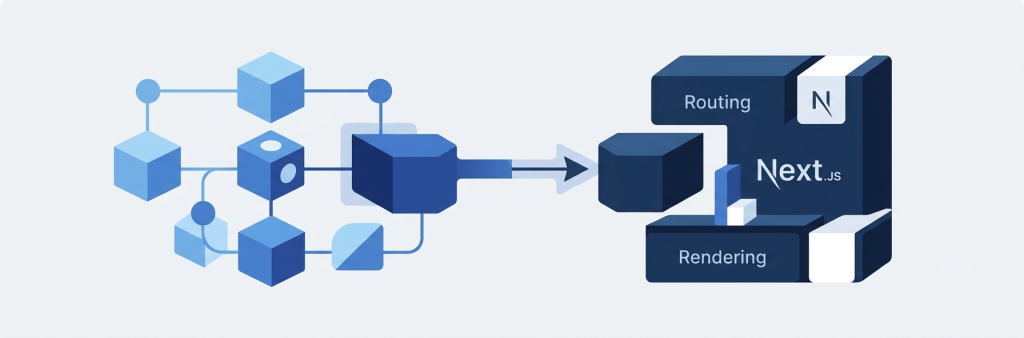
Migrating an existing React application to Next.js is possible and rarely requires a full rebuild. Teams commonly move routing, pages, layouts, APIs, and rendering logic incrementally, one section at a time, while the rest of the application keeps running as before. Overall complexity depends largely on how the existing application is structured and how many external dependencies it carries.
This incremental path also clears up the field’s most persistent misconception, which is that Next.js is somehow replacing React. It is not. Every Next.js application still runs on React underneath, and whenever React introduces new capabilities, such as server components or concurrent rendering features, Next.js integrates and extends them rather than working around them. The two technologies continue to move forward together rather than competing for the same role.
Frequently Asked Questions
- Is Next.js faster than React? Not inherently. Next.js includes built-in rendering and optimization techniques that often produce faster initial page loads and stronger Core Web Vitals than a typical client-rendered React application.
- Can an entire application be built using React only? Yes. React can power a complete application, though additional libraries are usually needed for routing, data fetching, SEO, and server-side rendering.
- Does Next.js improve SEO? Yes. Server-side rendering, static generation, metadata handling, and built-in performance optimizations make Next.js well suited for search-friendly websites.
- Which is easier to learn, React or Next.js? React is the foundation and is worth learning first. Next.js adds concepts such as routing strategies and rendering modes, though these additions ultimately simplify production work rather than complicate it.
- Should a start-up choose React or Next.js? For most start-ups building customer-facing products, Next.js is usually the stronger choice, since it combines the flexibility of React with built-in performance, SEO, and scalability. Internal tools and admin dashboards, meanwhile, may still be well served by React alone.
Final Verdict
Choosing between React and Next.js is not about picking a winner; it is about selecting the right level of abstraction for the project at hand. Teams that need only a UI library, along with full control over their own architecture, will still find React an excellent choice. Teams building a production application that depends on strong SEO, fast performance, and server-side rendering will generally find Next.js the more practical path. Because Next.js is built on React, choosing it does not mean leaving React behind; it means adopting a framework that delivers production-ready applications more efficiently.
With that in mind, choosing the right architecture early saves development time and reduces long-term maintenance costs, whether the goal is a start-up MVP, a migration from an existing React codebase, or a high-performance platform built from scratch. At Web Experts Nepal, our team follows a structured React development process to build scalable React and Next.js applications for start-ups, businesses, and enterprises worldwide, handling everything from architecture planning through deployment and long-term support. Contact us to discuss your project and find out which approach fits your goals best.
Contact UsRelated resources.

Why Enterprises Still Choose WordPress

HubSpot and WordPress: How To Connect The Two Platforms The Right Way

Migrating From Wix or Squarespace to WordPress: A Practical Guide
Have an idea worth building?
Share your concept with us and we’ll help you shape the right approach.